Hermite-NGP: Gradient-Augmented Hash Encoding for Learning PDEs
Georgia Institute of Technology
ICML 2026
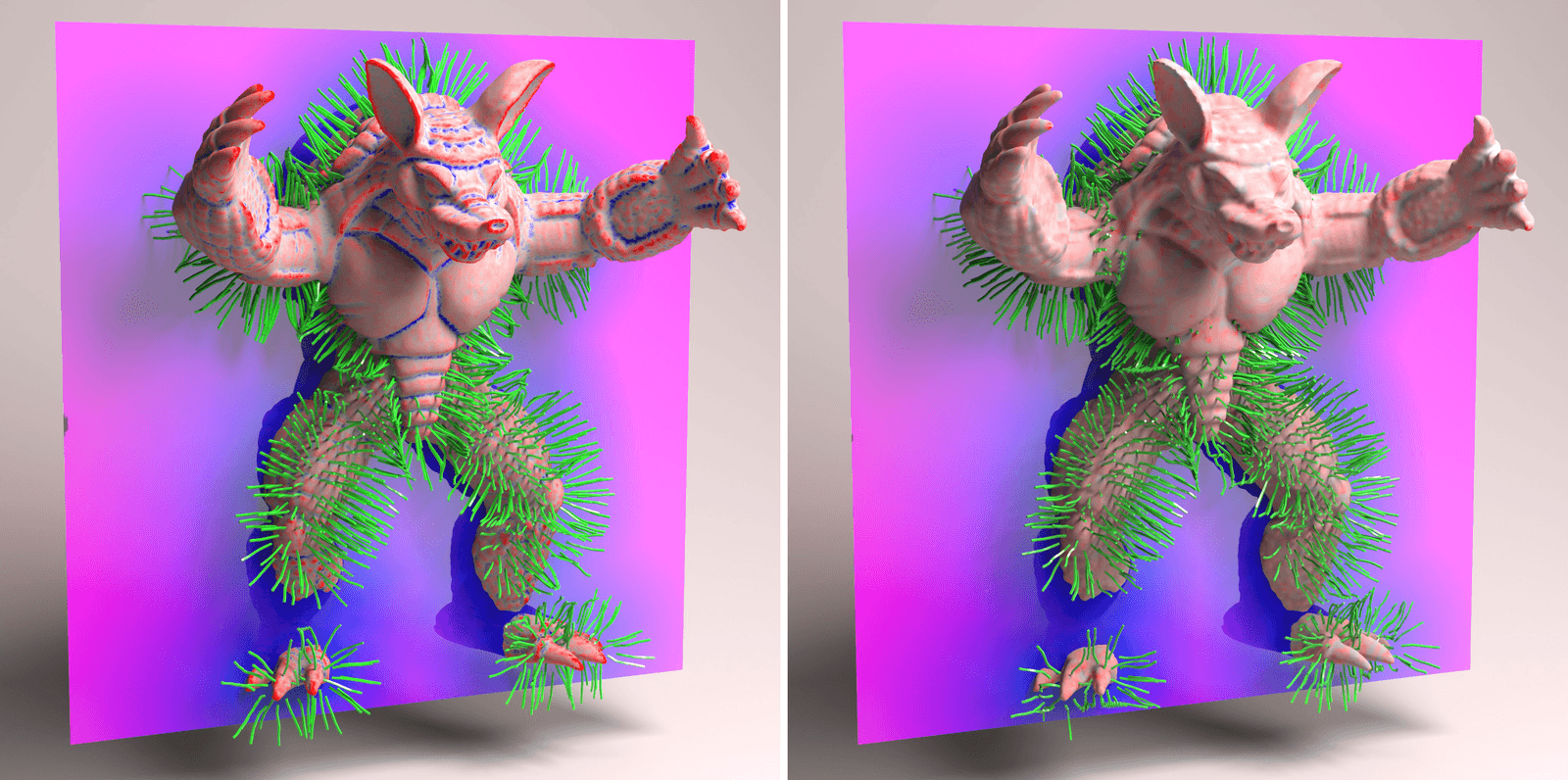
SDF Gradients and Curvature on Armadillo
Figure 1 — SDF Gradients and Curvature on Armadillo. Our method (left) recovers smoother gradient and curvature fields than NeuralAngelo (right), used here as an FD-based hash-encoding baseline under the same SDF + gradient objective. Gradients are visualized as green line segments around the surface, while curvature is shown via mesh coloring.

Abstract

We propose Hermite-NGP, a gradient-augmented multi-resolution hash encoding designed to enable fast and accurate computation of spatial derivatives for neural PDE solvers. Unlike existing NGP-based approaches that rely on automatic differentiation or finite differences and suffer from instability or high cost, Hermite-NGP explicitly stores function values and mixed partial derivatives at hash grid vertices, allowing fully analytic evaluation of gradients, Jacobians, and Hessians via Hermite interpolation. This design preserves the efficiency and spatial adaptivity of NGP while supporting analytic differential operators up to second order. We further introduce a multi-resolution curriculum training strategy analogous to multigrid V-cycles to enable coarse-to-fine optimization. Across a range of 2D and 3D PDE benchmarks, Hermite-NGP achieves up to ~20× lower error than prior neural PDE methods, and reduces wall-clock convergence time by 2–10× compared to other solvers, with per-epoch training times as low as 3.5 ms for models with up to 17M parameters.

Method
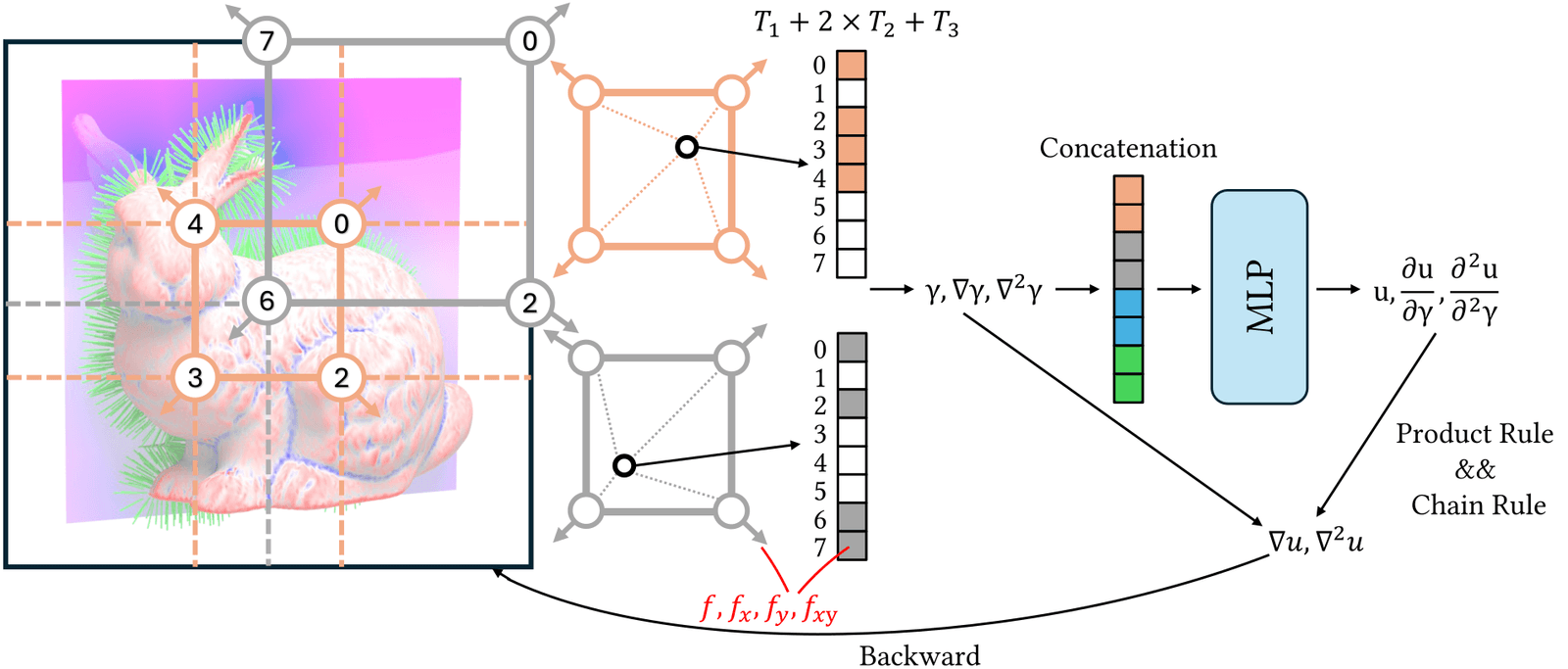
Hermite-NGP workflow diagram
Figure 2 — Hermite-NGP Workflow. Multi-resolution grids store Hermite coefficients $(f, f_x, f_y, f_{xy})$ in separate hash tables with sizes $T_1$ (values), $T_2$ (first derivatives), and $T_3$ (mixed derivatives), producing encoding $\gamma, \nabla\gamma, \nabla^2\gamma$. The MLP outputs $u$, $\partial u/\partial\gamma$, $\partial^2 u/\partial\gamma^2$, combined via chain rule to yield $\nabla u, \nabla^2 u$ for the PDE loss.
Gradient-augmented interpolation illustration
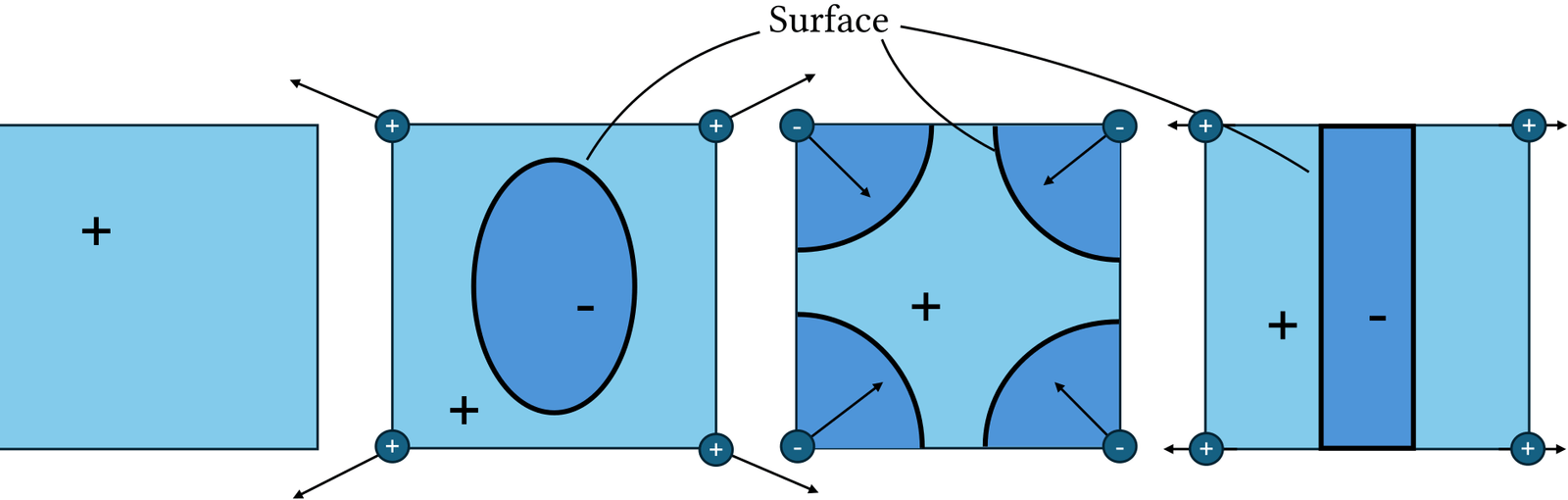
Figure 3 — Gradient-Augmented Illustration. The left cell without gradients yields constant interpolation, while the others use gradients to produce rich sub-grid features.

Results

Helmholtz 3D solution slices
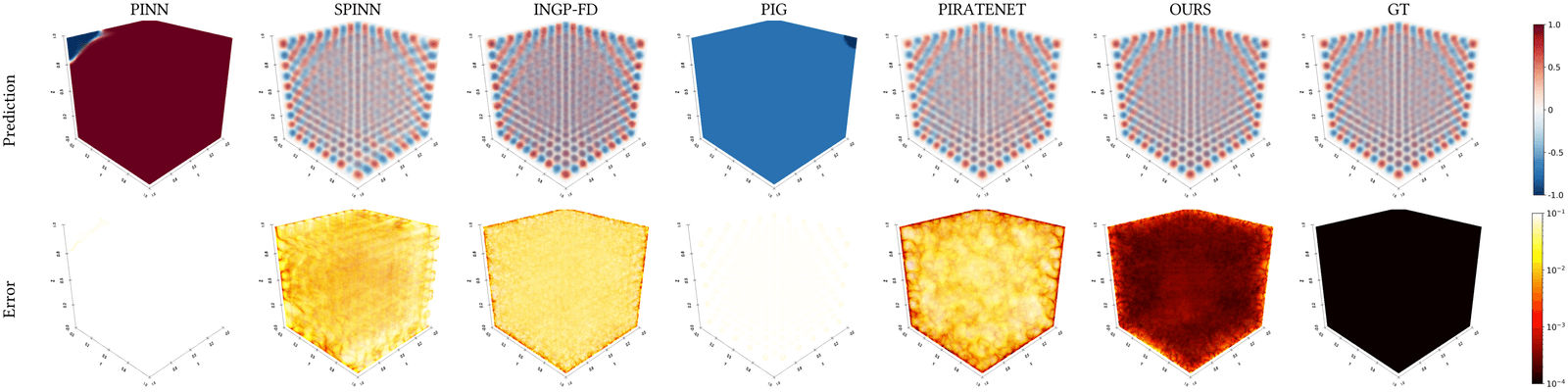
Figure 4 — Helmholtz 3D ($a{=}10$). Cross-sectional slices of the 3D Helmholtz solution. Hermite-NGP accurately captures the oscillatory wave patterns, achieving an $L^2$ error of $6\times10^{-3}$, substantially better than the closest baseline, I-NGP-FD ($7.21\times10^{-2}$).
1+1D convection solution at final time
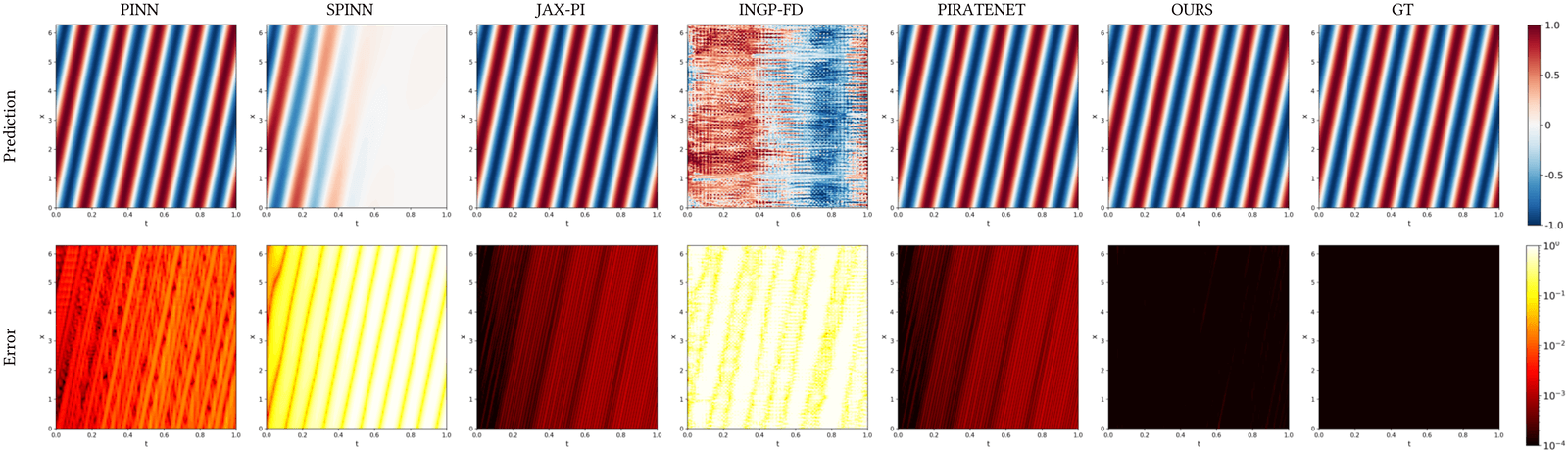
Figure 5 — Convection 1+1D ($c=30$). Solution field at final time. Hermite-NGP preserves the sharp traveling wave with $L^2 = 8.49\times10^{-5}$, a 10× improvement over PirateNet ($8.54\times10^{-4}$); SPINN and INGP-FD failed to converge.
Helmholtz 2D a=10: ground truth, prediction, pointwise error
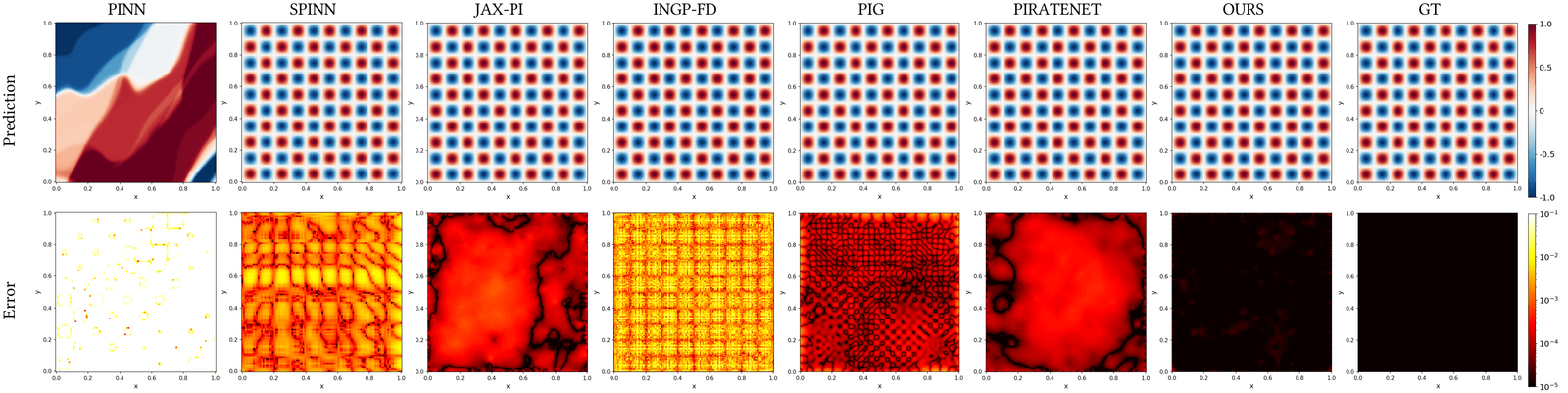
Figure 6 — Helmholtz 2D ($a=10$). Ground truth (left), Hermite-NGP prediction (middle), and pointwise error (right). Our method achieves relative $L^2$ error of $1.81\times10^{-5}$, compared to $3.57\times10^{-4}$ for the closest baseline.
Helmholtz 2D a=100 enlarged
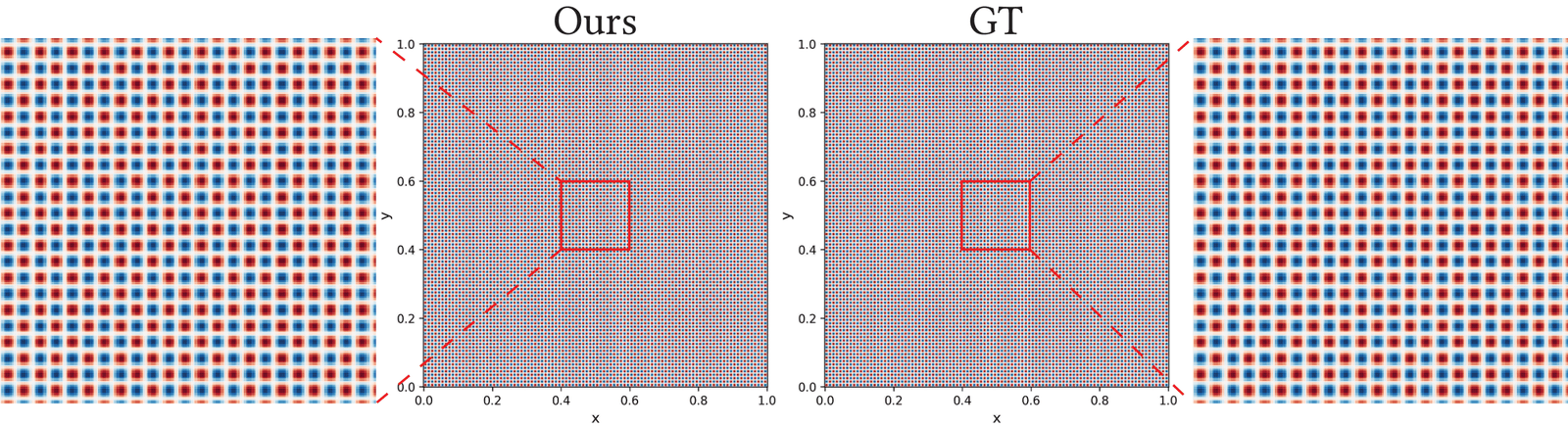
Figure 7 — Helmholtz 2D ($a=100$) enlarged. Hermite-NGP is the only method that converges on this challenging high-frequency setting, achieving $L^2 = 4.59\times10^{-2}$. All baseline methods fail to capture the rapid oscillations.
Training loss curves across benchmarks
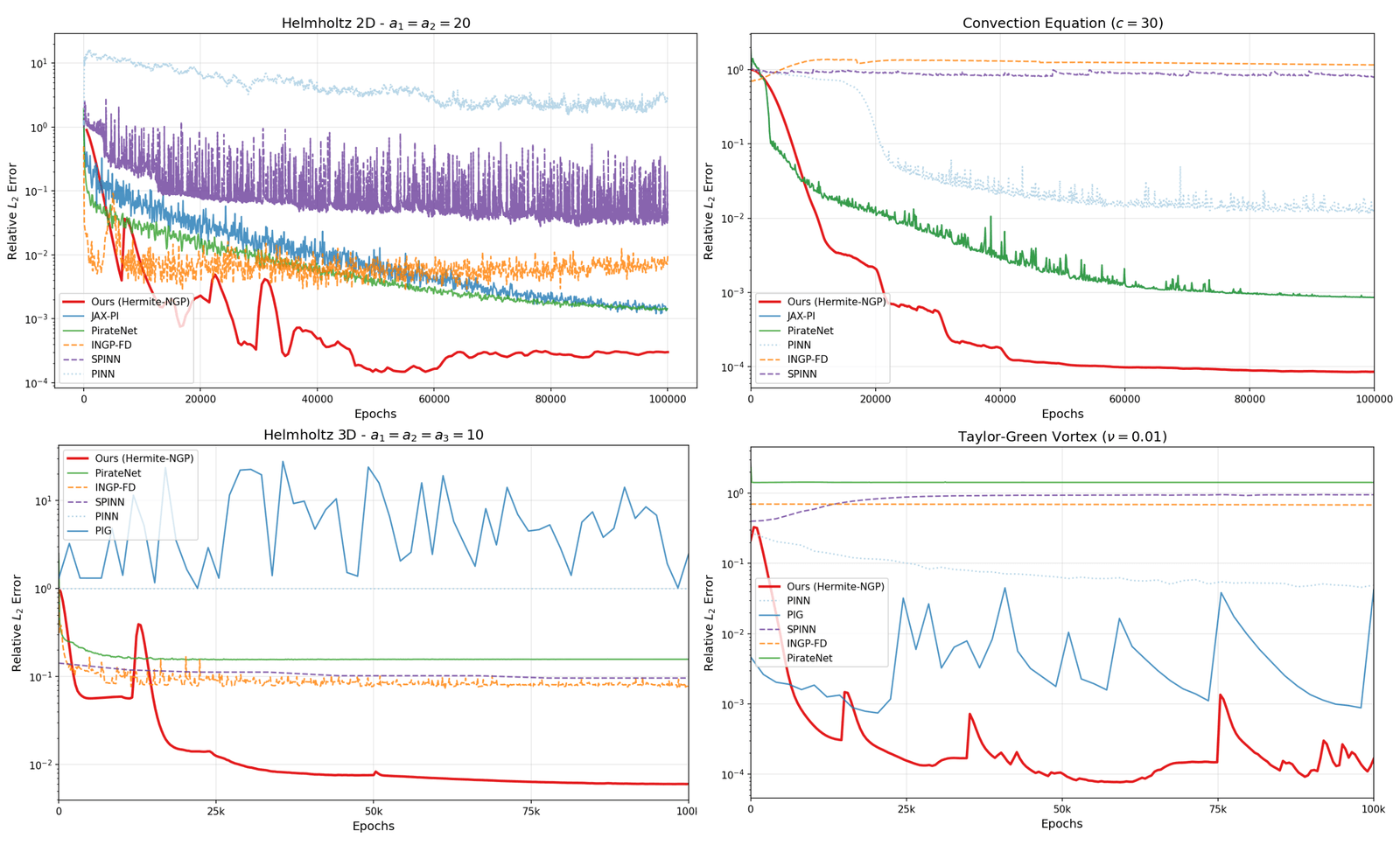
Figure 8 — Training loss curves across four benchmarks. Our method’s loss curve decreases smoothly, in contrast to the highly oscillatory behavior of the baselines, and converges to errors up to four orders of magnitude lower across different benchmarks.
Helmholtz 2D a=10 comparison across Hermite-NGP, partial-infinity Grid, SIREN
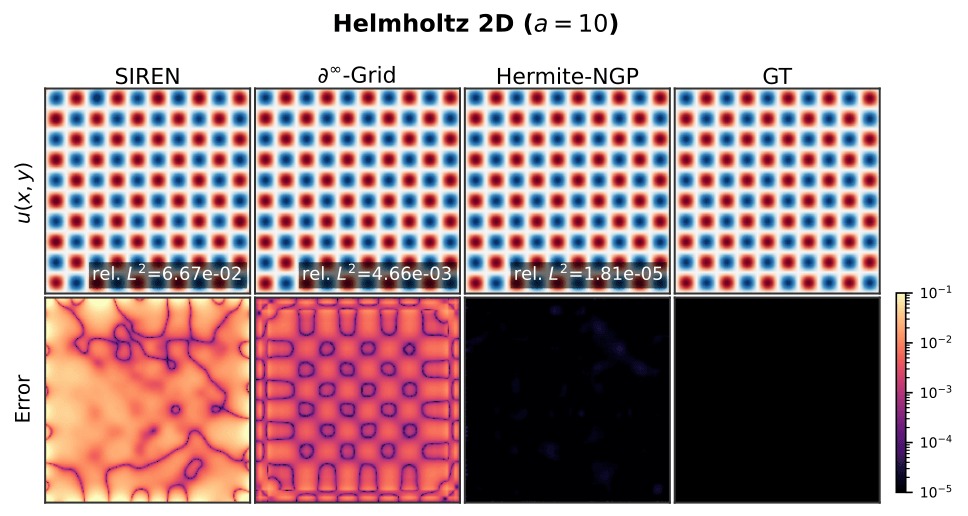
Figure 9 — Helmholtz 2D ($a{=}10$) qualitative comparison. Across Hermite-NGP, $\partial^\infty$-Grid, and SIREN, only Hermite-NGP recovers the high-frequency structure cleanly.
Taylor-Green vortex velocity magnitude at t=1
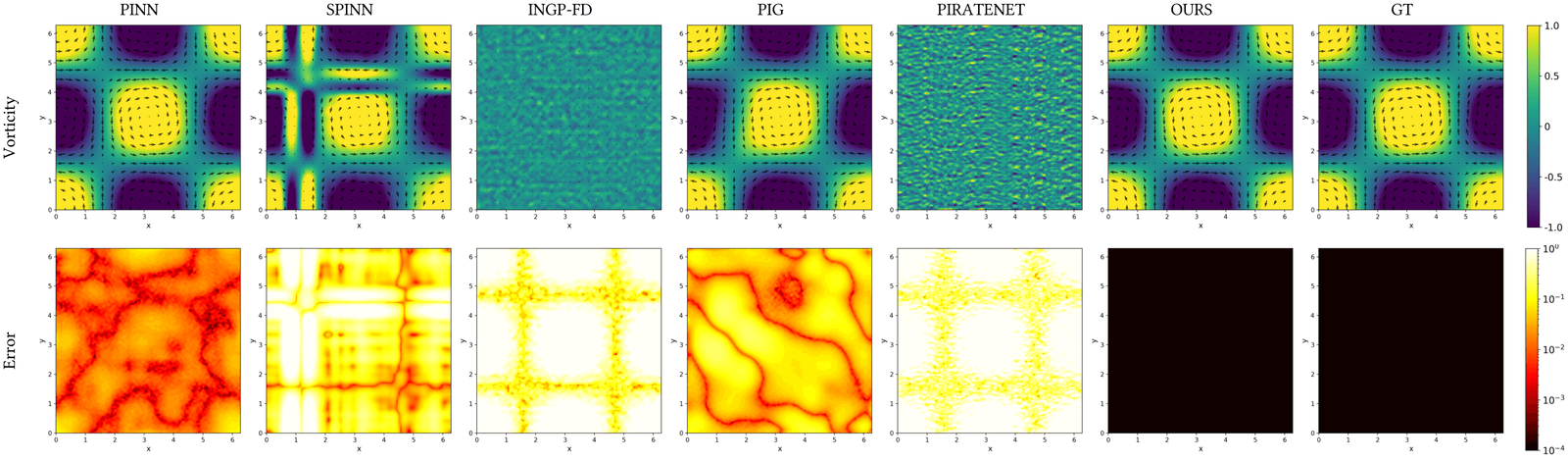
Figure 10 — Taylor–Green vortex ($\nu=0.01$). Velocity magnitude at $t=1$. Hermite-NGP captures the decaying vortex structure with $L^2 = 7.71\times10^{-5}$, outperforming PIG by 9×.
Flow mixing solution field
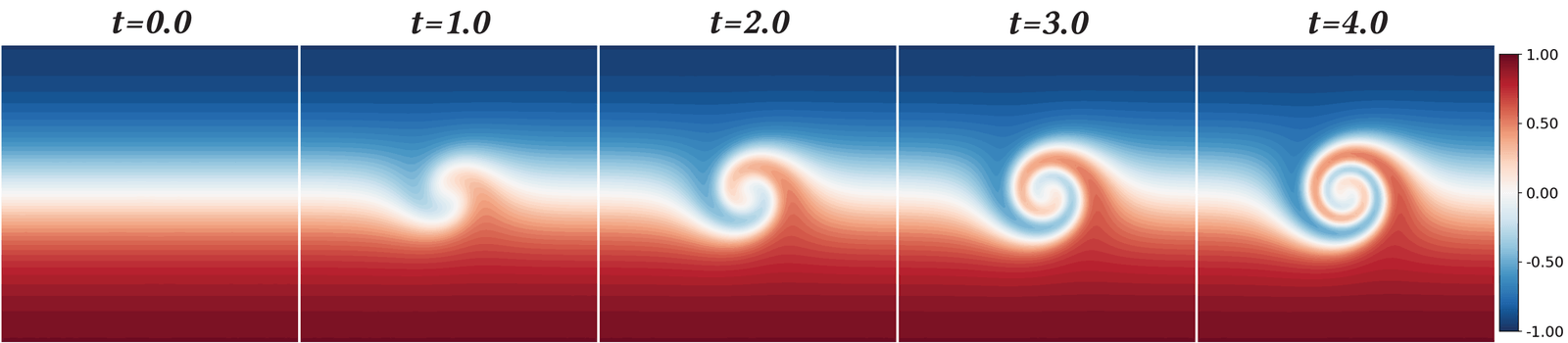
Figure 11 — Flow Mixing. Solution field showing rotational transport. Hermite-NGP achieves $L^2 = 2.35\times10^{-4}$, resolving sharp gradients from fluid stretching.
SDF learning curvature on Dragon
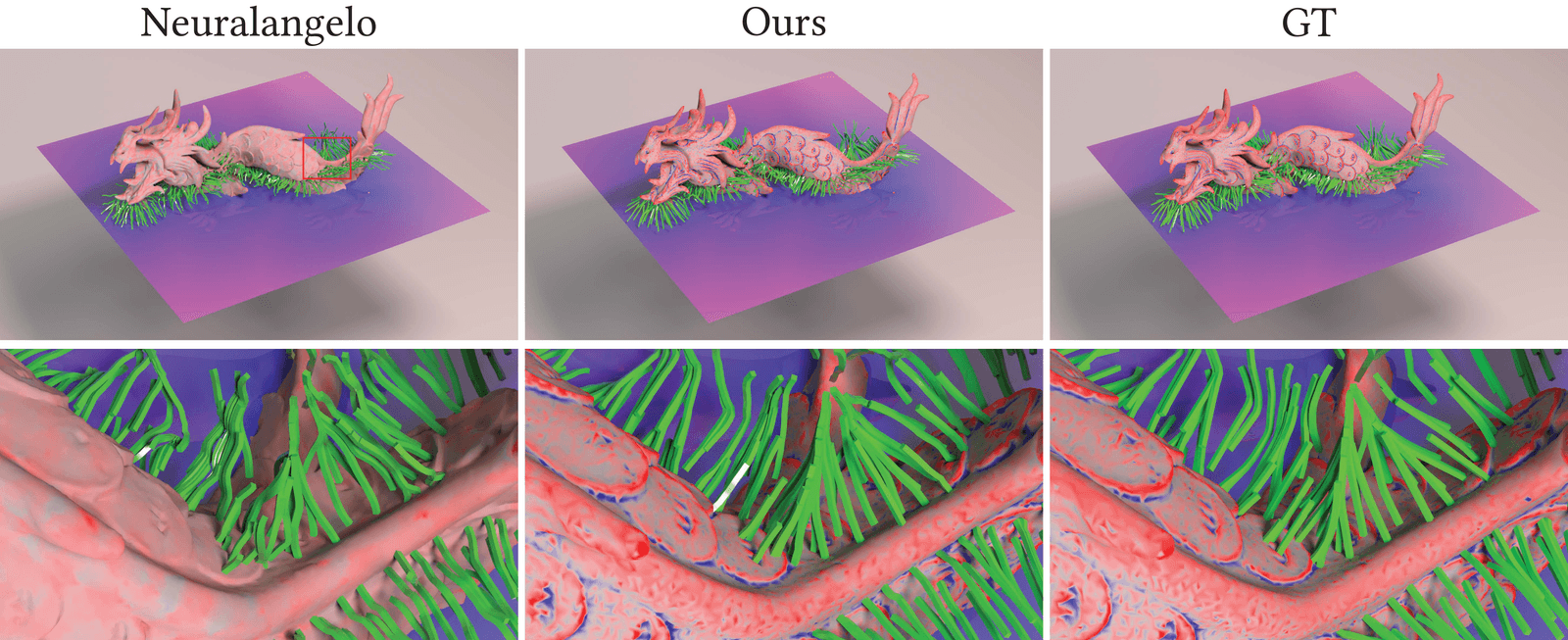
Figure 12 — SDF Learning and Curvature Estimation. Hermite-NGP learns an SDF whose gradients (green line segments) and curvature (shown as color) remain smooth thanks to analytic second derivatives, whereas NeuralAngelo’s finite-difference curvature is noisy and exhibits visible artifacts.
Image reconstruction from gradient supervision
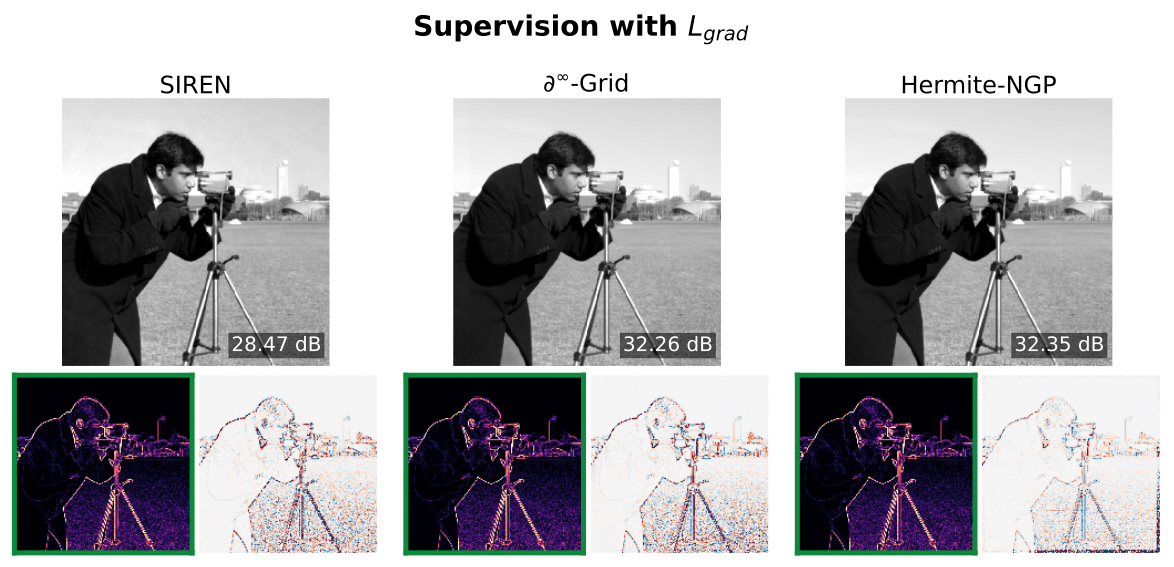
Figure 13 — Image Reconstruction from Gradient Supervision. On the camera image, Hermite-NGP recovers sharper edges and finer texture than $\partial^\infty$-Grid and SIREN while matching their soft-region quality.
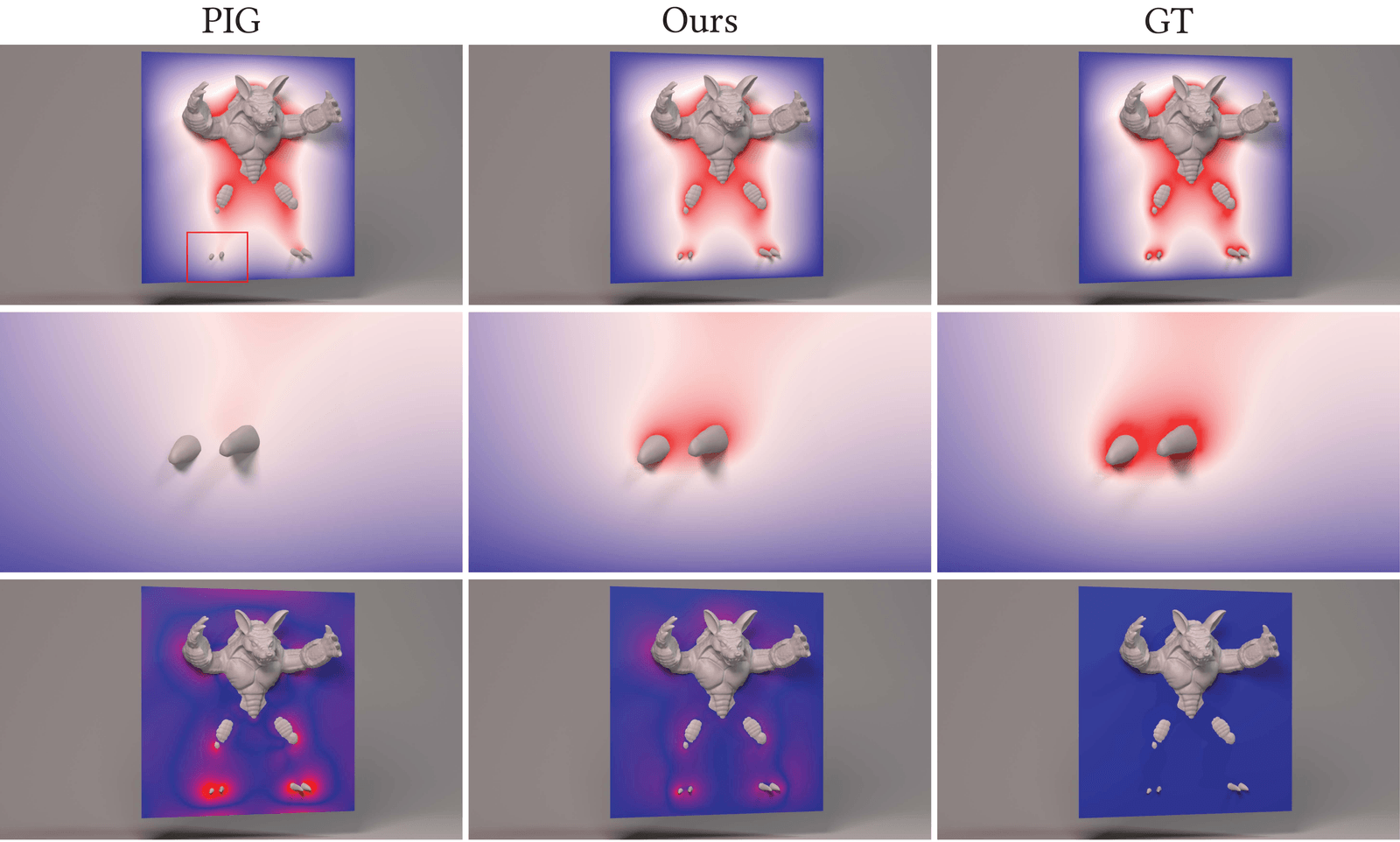
3D Poisson solution on Armadillo
Figure 14 — 3D Poisson with Mesh Boundary (Armadillo). Solution $u$ with Dirichlet values $u{=}1$ on the mesh surface and $u{=}0$ on the outer domain boundary. Hermite-NGP achieves an $L^2$ error of $5\times10^{-3}$, a 3× improvement over PIG. The third row shows $L^2$ error.

BibTeX

@inproceedings{he2026hermitengp,
  title     = {Hermite-NGP: Gradient-Augmented Hash Encoding for Learning PDEs},
  author    = {He, Jinjin and Li, Zhiqi and Wang, Sinan and Zhu, Bo},
  booktitle = {International Conference on Machine Learning (ICML)},
  year      = {2026}
}